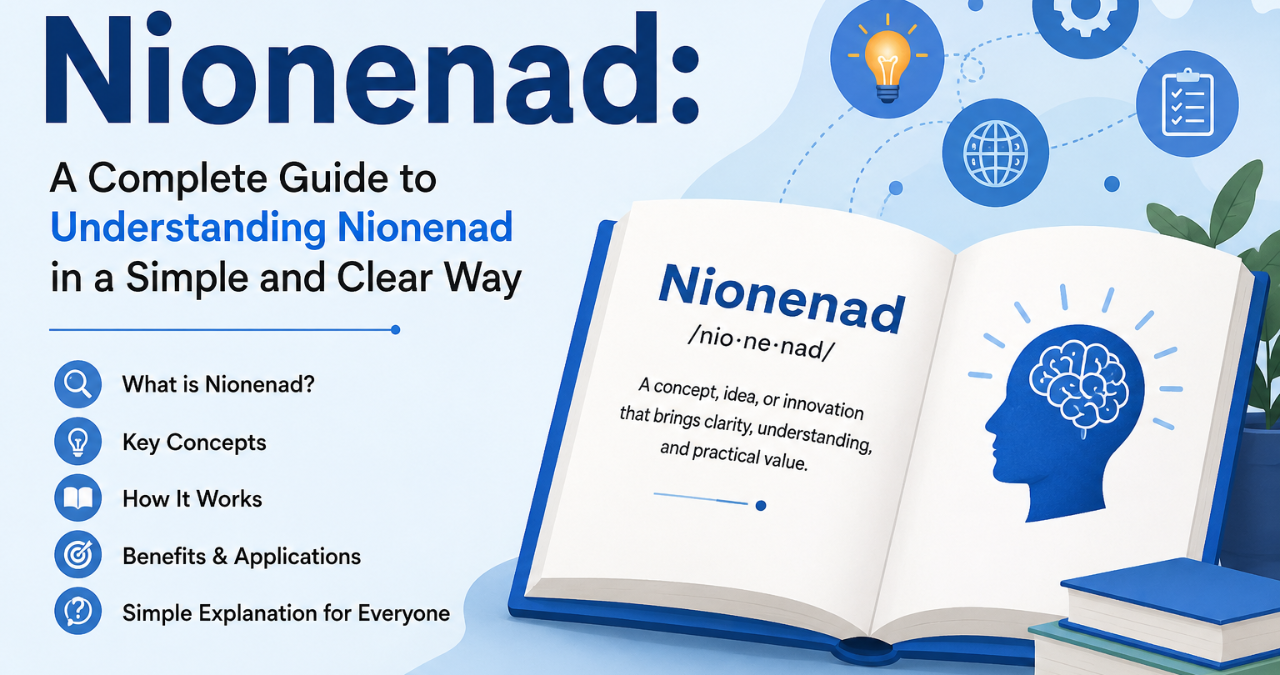

Nionenad is a term that may sound unusual at first, but once you explore it deeply, it becomes an interesting concept to understand and study. In this article, we will break down nionenad in a simple, human-like, and easy-to-read way so that even a Grade 7 student can fully grasp it. You will learn what it means, how it works, why it matters, and how it can be useful in different areas of life.
This guide on nionenad is written with clarity, creativity, and a strong focus on making complex ideas feel simple and engaging. So, let’s dive right in and explore everything step by step.
What is Nionenad and Why It Matters
Nionenad can be described as a conceptual framework that focuses on structured thinking, adaptive learning, and flexible problem-solving. In simple words, it is a way of understanding how systems, ideas, or processes can change and improve over time.
Many people use nionenad as a modern approach to organize thoughts and handle complex situations in a more balanced way. It helps in breaking big problems into smaller, manageable parts.
To make it easier, think of nionenad as:
- A mental map for solving problems
- A flexible system for organizing information
- A method for improving decision-making
- A way to adapt to changing conditions
Well, that might sound a bit technical, but don’t worry—it gets clearer as we move forward!
Origin and Evolution of Nionenad
The idea of nionenad did not appear overnight. Instead, it evolved slowly as thinkers, researchers, and learners tried to improve how humans understand complex systems.
In early stages, nionenad was mostly theoretical. It was discussed in academic spaces where experts explored better ways to simplify decision-making. Over time, it began to spread into other areas like education, technology, and even everyday problem-solving.
Interestingly, as people started using nionenad, they realized something important—it was not just a theory, but a practical tool that could be applied in real-life situations.
You know what? That’s when things got really exciting.
Even though the concept is still evolving, many believe that nionenad will continue to grow in importance as systems and technologies become more complex.
Core Principles of Nionenad
To truly understand nionenad, we must look at its core principles. These principles act like the foundation of a building—without them, the structure would not stand strong.
Here are the main principles:
Flexibility
Nionenad encourages flexible thinking. This means not sticking to one rigid idea but being open to change.
Simplification
Complex problems are broken into smaller parts, making them easier to understand.
Adaptability
The system adjusts based on new information or situations.
Interconnection
Everything is linked. One change can affect many parts of a system.
Continuous Improvement
Nionenad supports constant learning and improvement over time.
Honestly, when you look at these principles, it feels like nionenad is designed to help people think smarter, not harder.
How Nionenad Works in Practice
Now, let’s make things practical. How does nionenad actually work in real life?
The process usually follows a simple flow:
- Identify the problem
- Break it into smaller parts
- Analyze each part separately
- Find connections between the parts
- Create solutions based on understanding
- Test and improve continuously
For example, imagine a student struggling with studies. Using nionenad, they would not just say, “I don’t understand anything.” Instead, they would:
- Identify weak subjects
- Focus on one topic at a time
- Understand patterns in learning
- Improve step by step
See? It becomes much easier when broken down.
And yes, even in messy real-life situations—like planning a project or solving a team issue—nionenad helps bring order to confusion.
Benefits of Nionenad in Everyday Life
There are many advantages of using nionenad, especially when dealing with complex tasks or decisions.
Improves Thinking Skills
It trains the brain to think in a structured and logical way.
Reduces Stress
Breaking problems into smaller pieces makes them less overwhelming.
Better Decision-Making
You can see all angles before choosing a solution.
Saves Time
Instead of guessing, you follow a clear process.
Encourages Learning
It promotes continuous improvement and curiosity.
Oh, and here’s a fun thought—even when life gets a bit chaotic (like unexpected events or, well, idiodid nicole kidman and keith urban splitms level confusion), nionenad helps bring things back into order by encouraging structured thinking.
Challenges of Nionenad
Of course, no system is perfect, and nionenad also comes with its challenges.
Requires Practice
You cannot master it overnight. It takes time and patience.
Complex at First
The idea might feel confusing when you are new to it.
Needs Consistency
If not applied regularly, it loses effectiveness.
Overthinking Risk
Sometimes breaking things into too many parts can slow decision-making.
Even so, these challenges are not deal-breakers. They are just part of the learning journey.
Real-World Applications of Nionenad
Nionenad is not just a theory—it can be used in many areas of life.
Education
Students use it to break down subjects and improve understanding.
Business
Companies use it for planning strategies and solving problems.
Technology
Developers apply similar thinking to design better systems.
Healthcare
Medical professionals can use structured analysis for better diagnosis.
Daily Life
From budgeting money to planning a trip, nionenad can help simplify everything.
It’s honestly surprising how one concept can fit into so many areas, right?
Comparison Table of Nionenad Concepts
Here is a simple table to help you understand nionenad better:
| Aspect | Description | Benefit |
|---|---|---|
| Flexibility | Adapts to change easily | Helps handle uncertainty |
| Simplification | Breaks problems into parts | Makes tasks easier |
| Adaptability | Adjusts to new information | Improves accuracy |
| Interconnection | Links different ideas | Builds better understanding |
| Continuous Improvement | Keeps evolving | Long-term growth |
This table shows how nionenad works as a complete system rather than a single idea.
Future of Nionenad
The future of nionenad looks promising. As the world becomes more digital and complex, people need better ways to think and solve problems.
Experts believe that nionenad could become more widely used in:
- Artificial intelligence systems
- Education models
- Business strategy tools
- Personal development methods
In the coming years, it may even become a common part of learning systems in schools and workplaces.
So, in a way, nionenad might shape how future generations think and learn.
Frequently Asked Questions About Nionenad
What is the main purpose of nionenad?
The main purpose of nionenad is to simplify complex thinking and improve problem-solving skills.
Is nionenad difficult to learn?
Not really. It may feel confusing at first, but with practice, it becomes easier.
Can students use nionenad?
Yes, students can use it to improve learning and organize their studies better.
Is nionenad used in real life?
Absolutely. It is used in education, business, technology, and daily life.
Does nionenad require special tools?
No special tools are needed. It is mainly a thinking method.
Final Thoughts on Nionenad
In conclusion, nionenad is a powerful and flexible concept that helps people think clearly, solve problems efficiently, and adapt to changing situations. Even though it may sound complex at first, it becomes very practical once you understand its core ideas.
From education to business and even daily decision-making, nionenad proves to be a valuable tool for improving how we think and act in the world.
As we move into a future filled with rapid changes and growing complexity, the importance of structured thinking like nionenad will only continue to rise.
And finally, remember this: mastering nionenad is not about being perfect—it’s about improving step by step, learning continuously, and staying open to new ideas.
Nionenad is not just a concept—it is a smarter way of thinking about life, learning, and growth.
Explore More: [alltechhub.blog]